


Three Embedded Insurance Offers Your Fintech Can Add Without Rebuilding Your App
If you run product, growth, or partnerships at a fintech, wallet, lending app, logistics platform, or marketplace, you probably want two things at once:
- More revenue per user
- More trust and stickiness
But you don’t want a year-long core integration project just to test an insurance idea.
The good news: you don’t need one.
With embedded insurance, you can layer simple, high-impact covers into journeys you already have. If you want a deeper strategic view, Curacel has a full embedded insurance guide for fintech and credit companies.
This post zooms in on three specific offers you can ship quickly with Curacel Grow as the infrastructure underneath.
Offer 1 – Card & Wallet Protection for Everyday Users
What it is
Lightweight cover that protects customers when things go wrong with their cards or balances:
- Fraudulent transactions
- Stolen cards or phones
- Compromised wallet balances
It’s easy to explain and usually priced low enough to feel like a “why not?” add-on.
Where it fits
- Card management screen – where users already adjust limits, freeze, or change PINs
- Onboarding flow – as an optional “Add protection in one tap” step
Simple UX pattern
- A toggle or checkbox
- One clear line of copy
- A small, transparent recurring fee
“Protect your cards and wallet balance for ₦200/month. Covers fraud and theft up to ₦XX,XXX.”

Metrics to watch
- Attach rate – % of active cards/wallets with protection
- Claims frequency & loss ratio – to keep the product sustainable
- NPS / CSAT – does it make users feel safer using your app?
Offer 2 – Loan Protection for Credit Products
If you offer salary advances, BNPL, micro-loans, or SME credit, loan protection can improve both customer outcomes and portfolio quality.
What it covers
Depending on your market and insurer:
- Death
- Disability or serious illness
- Job loss or income interruption
When covered events occur, insurance steps in so the loan doesn’t turn into bad debt.
Where it fits
- Loan confirmation page – just before “Confirm loan”
- Renewal / reminder flows – emails or in-app prompts for recurring borrowers
UX pattern
Make the protection feel like a natural, optional enhancement:
“Add Loan Protection for ₦350/month. If you lose your job or are permanently disabled, your remaining balance is covered.”
Show:
- The extra monthly cost
- A very short “What’s covered” summary
- A link to full terms for those who want details
How it helps risk & collections
- Fewer charge-offs when life events hit borrowers
- Better conversations with customers (“we planned for this together”)
- Cleaner performance metrics for your credit portfolio
Offer 3 – Delivery & Purchase Protection for Logistics / Commerce
For logistics and commerce platforms, every failed delivery is a potential support headache and a hit to trust.
Delivery and purchase protection helps de-risk that experience.
What it covers
- Loss or theft in transit
- Physical damage
- Certain delays, depending on design
Where it fits
- Checkout page – as a small optional line item in the order summary
- Track-order screen – for high-value items that are about to ship
UX pattern
“Protect this delivery for ₦150. Covers loss or damage up to ₦XX,XXX.”
Keep it:
- Short (one sentence)
- Cheap relative to order value
- Easy to understand at a glance
Trust + ops benefit
- Fewer disputes and chargebacks
- Standardised responses when something goes wrong
- A visible signal that your platform “has customers’ backs”
For a broader playbook on how platforms can treat embedded insurance as a growth and trust lever, see Curacel’s embedded insurance playbook for fintechs and e-commerce platforms.
How Curacel Grow Handles the Heavy Lifting
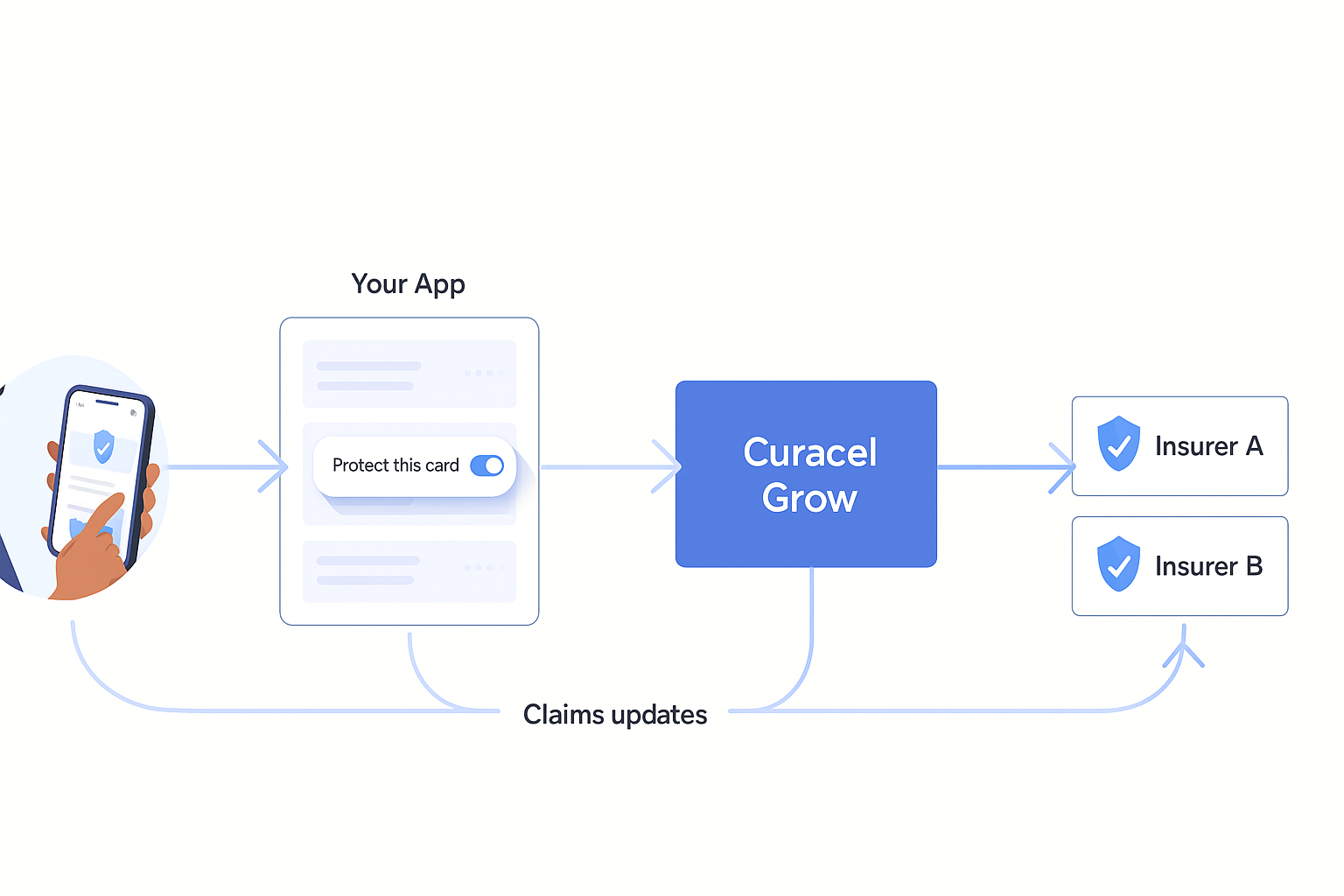
Behind these simple UX patterns, you still need serious insurance plumbing. Curacel Grow provides that for you.
With Grow, digital businesses can:
- Plug into ready-made products designed for fintech, logistics, and commerce
- Create and manage policies via APIs tied to cards, loans, orders, or users
- Connect claims flows to Curacel’s AI-powered claims infrastructure
- Track performance – attach rate, revenue, claims – in one place
For your team, that means:
- Product focuses on a few new touchpoints, not a new product line from scratch
- Engineering adds minimal backend changes – just the flows needed to call Grow’s APIs
- Ops and support get clear, repeatable processes when users need to claim
A Simple 4-Week Launch Plan
You don’t need a big-bang launch. Start small and learn fast.
Week 1 – Choose one offer
- Pick the offer that best fits your current traffic:
- High card use → card & wallet protection
- Strong lending book → loan protection
- Heavy shipping volume → delivery protection
- High card use → card & wallet protection
- Map one or two screens where it will appear.
Week 2–3 – Build and integrate
- Design the copy and UI components.
- Connect those screens to Curacel Grow for policy creation and tracking.
- Run internal tests and fix edge cases.
Week 4 – Soft launch & measure
- Roll out to a limited user segment (e.g., 5–10% of eligible users).
- Track attach rate, support feedback, and any early claims.
- Iterate on pricing, placement, and messaging before scaling.
Plan Your First Embedded Offer
If embedded insurance is on your roadmap (or you’re just curious), we can help you shortcut the trial-and-error.
Share your current checkout, card, or loan journey, and we’ll:
- Recommend which of these three offers to start with
- Show you what integration with Curacel Grow looks like (flows, APIs, timelines)
- Help you design a 4-week rollout plan tailored to your product
👉 Book a discovery call – tell us about your product, and we’ll help you ship your first embedded insurance offer without rebuilding your app.
Abonnez-vous à notre newsletter pour recevoir du contenu hebdomadaire






.svg)


