


You Have a Cost You’ve Never Counted
You Have a Cost You’ve Never Counted
Every business owner can tell you their revenue. Most can tell you their rent, their payroll, their biggest line items down to the decimal.
Almost none can tell you what it costs them to ask to be paid.
That sounds like a strange thing to have a cost at all. Sending an invoice feels free. You build the document, you attach it to an email, you hit send. Where is the cost in that? But the cost is real, and it is larger than you would guess. Ardent Partners, in its State of ePayables research, puts the average cost of processing a single invoice by hand at around 13 dollars, and other industry estimates run as high as 30. Not the goods. Not the service you delivered. The invoice itself.
Now multiply that by every invoice your business sent last month. Sit with that number for a moment, because it is almost certainly the first time anyone has asked you to.

Why the Cost Stays Invisible
Here is the strange thing about cost. The expenses we fear are the ones we can see. They arrive as a bill. They sit on a statement. Rent, salaries, inventory: visible, named, managed.
The cost of a manual invoice is none of those things. It hides inside salaried time that is already being paid for. A few minutes of data entry here. A chased approval there. A re-keyed figure, a reprinted page, a follow-up call to confirm the thing arrived. No single moment is big enough to flag. So the total is never added up, and what never gets measured never gets managed.
This is why the cost stays invisible. Not because it is small, but because it is scattered. It is a hundred tiny frictions that nobody ever sums into one frightening line.
The Cost Is Bigger Than the Number
The 12 to 30 dollars is only the part you can see once you look. The real damage compounds underneath it.
There are errors. Manual invoicing carries a far higher error rate than automated processing, and every mistake means rework, re-approval, and delay. There are duplicates. SAP Concur found that the typical small or mid-sized business sees a duplicate invoice rate of around 1.3 percent, with each duplicate worth an average of 2,034 dollars, enough to put roughly 12,000 dollars a month at risk of being paid twice. That is money walking out the door twice, quietly, while everyone assumed the system caught it.
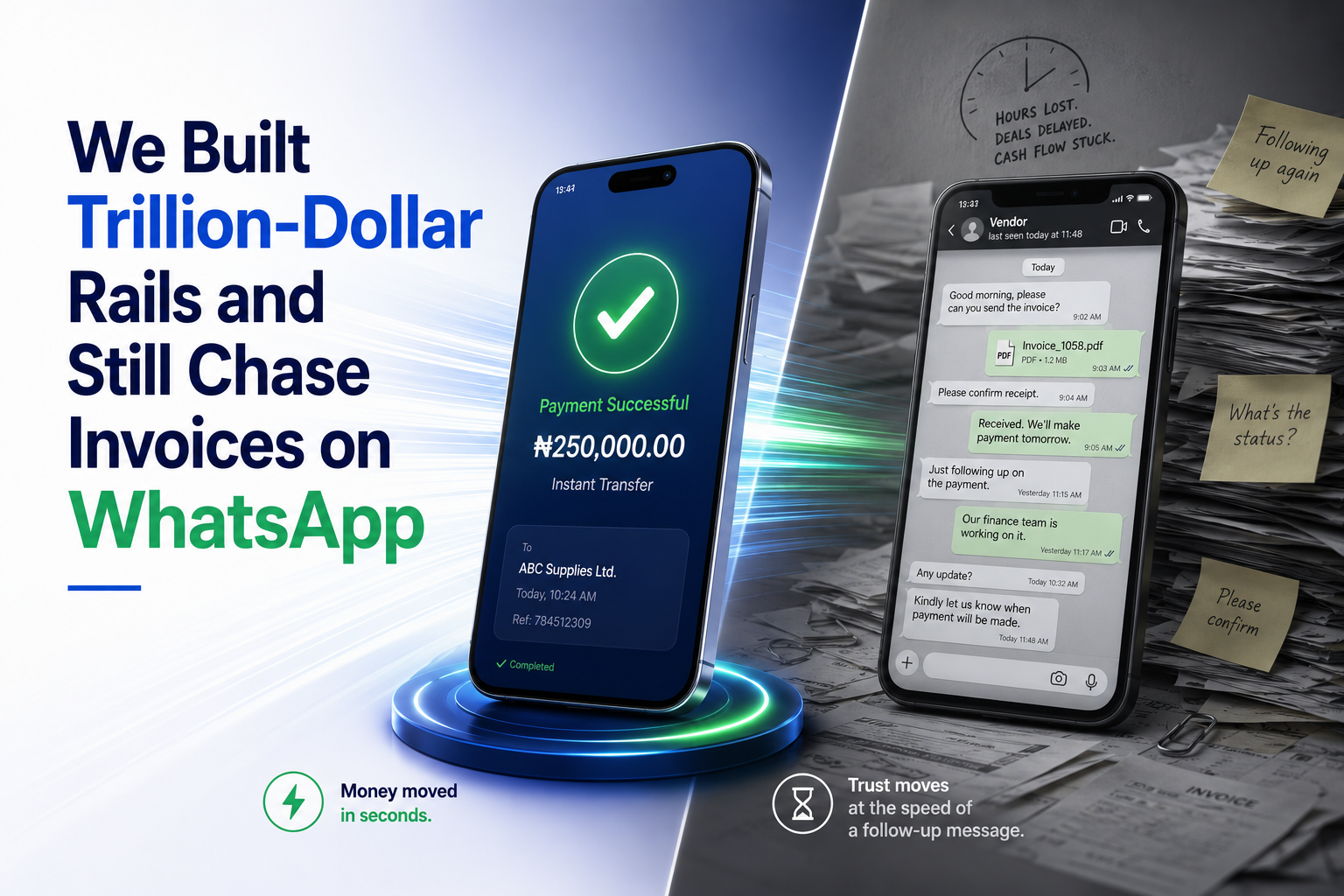
And then there is the most expensive cost of all: the wait. The median business-to-business invoice takes around 56 days to turn into cash, according to Upflow. In Africa, the friction starts even earlier. Duplo found that 44 percent of businesses wait more than a day just to be paid at all. That is not a delay. It is your own money, earned and owed, sitting in someone else’s account while you make payroll out of what’s left.
Trust, With a Price Tag
Strip an invoice down and here is what it really is. A promise with a date on it. Pay me for what I already delivered. It is trust, written down.
So every cost we just named is the cost of trust moving too slowly. The hours of admin are friction in the promise. The duplicate payment is trust spent twice. The 56-day wait is trust stuck in motion, somewhere between done and paid. When invoicing is manual, trust is expensive, slow, and fragile. And you have been paying for that fragility all along, in a currency you never tracked.
Once You See It, You Can’t Unsee It
This is the uncomfortable part. The moment you start counting, you cannot stop. The minutes become hours. The hours become salaries. The occasional duplicate becomes a leak. The 56-day wait becomes the reason a profitable quarter still felt tight.
None of it was ever hidden on purpose. It was just never named. But naming it is the whole game, because a cost you can see is a cost you can fix. Structured, automated invoicing exists precisely to collapse this: to take the price of an invoice from double digits down to cents, to make duplicates impossible instead of merely unlikely, and to turn the wait from weeks into something far shorter.
👉 See how Curacel Pay closes the loop from invoice to payment to reconciliation at curacel.co.
The Takeaway
You have always known your revenue. Now you know there is a number sitting right next to it that you have never counted: the cost of getting paid the manual way. It is real, it compounds, and it has been quietly shaping your cash flow the entire time.
The businesses that win the next decade will be the ones that finally measure it, then refuse to keep paying it.
Ready to stop paying a cost you can’t see? See how Curacel Pay works at curacel.co.
Abonnez-vous à notre newsletter pour recevoir du contenu hebdomadaire





.svg)


