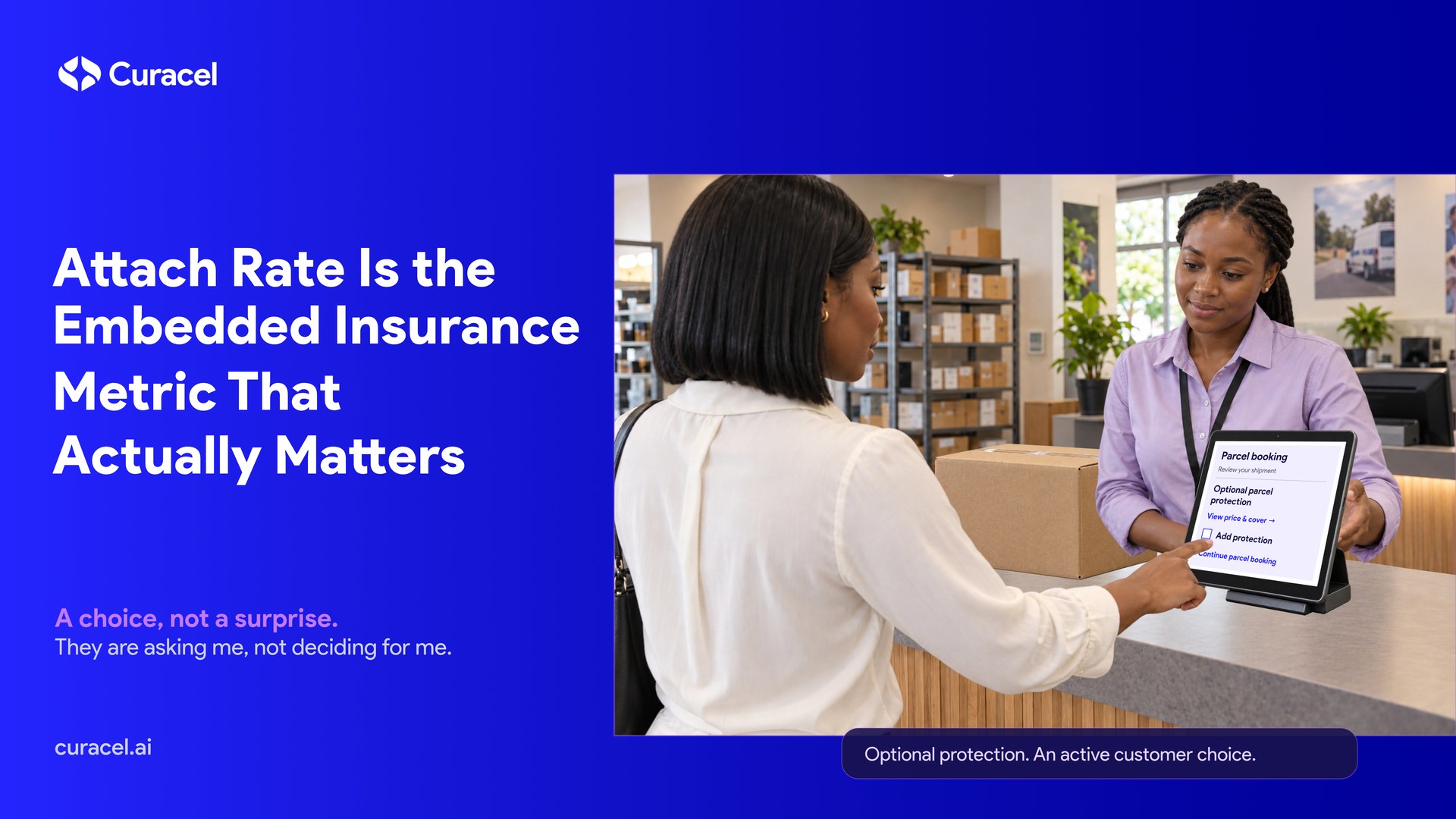
Attach Rate Is the Embedded Insurance Metric That Actually Matters
Attach Rate Is the Embedded Insurance Metric That Actually Matters
A platform can double its transactions without making its insurance offer more useful. If insurance sales rise only because the underlying business grows, the distribution team may celebrate a result it hasn't improved.
Attach rate asks a harder question: when an eligible customer completes the core transaction, how often does relevant cover attach? It puts the insurance decision back in view instead of hiding it inside platform volume.
Digital access isn’t insurance demand
Digital channels create opportunities to offer protection. They don't prove that customers understand the cover, want it or can afford it.
The World Bank’s Global Findex 2021 release reports that 57% of adults in developing economies made or received digital payments in 2021, up from 35% in 2014. That's evidence of payment behaviour, not an embedded insurance conversion benchmark.
For Sub-Saharan Africa, the same World Bank release reports that 33% of adults held a mobile money account in 2021. A familiar payment channel can make an offer accessible, but account ownership doesn't establish willingness to buy a policy.
The commercial question is narrower: does this cover fit the risk the customer faces during this transaction?
Fix the denominator before optimising the rate
For a voluntary transaction-linked offer, calculate attach rate as completed eligible transactions with successfully issued cover divided by all completed eligible transactions in the same cohort and period.
Use consistent rules. Count a transaction once even if several covers are purchased, and don't put ineligible transactions into the denominator. Report bundled or mandatory cover separately, because automatic inclusion doesn't measure voluntary purchase intent.
A second measure, offer conversion, uses eligible customers who actually saw the offer as its denominator. Keep both: a high offer conversion rate can conceal poor exposure across the eligible base.
- Eligibility: Define which completed transactions could receive the specific product.
- Exposure: Record whether the customer actually saw the offer and its price.
- Issuance: Count confirmed cover, not clicks, quote requests or failed payments.
- Cohort: Keep product, channel and reporting period consistent when comparing results.
Discuss embedded insurance workflows with Curacel Grow to explore how quotations, orders and policy management could fit your product journey.
Attach rate connects product fit to unit economics
Higher attachment isn't automatically better business. Discounted cover may convert while leaving little contribution. An aggressive offer may raise attachment and damage checkout completion.
For platform distribution economics, estimate contribution per eligible transaction as attach rate multiplied by net earned distribution revenue per attached policy, less the relevant variable distribution costs per eligible transaction. Don't mistake the full premium for platform revenue, or use this model as a substitute for an insurer’s underwriting economics.
Read the rate alongside safeguards:
- Contribution: Include actual commission terms, refunds and variable support costs.
- Core conversion: Check whether the offer changes completion of the underlying purchase.
- Customer outcomes: Review cancellations, complaints and whether buyers understand exclusions.
Make acceptance deliberate and the post-purchase journey usable. Keep the price, exclusions and claims route clear; don't use preselected cover to manufacture conversion. Check that policy confirmation reaches the customer after issuance. Compare support contacts and cancellations on the same eligibility basis, so a channel that sells more cover isn't mistaken for a better business when servicing costs or misunderstandings also rise.
This lets the team distinguish a useful offer from a persuasive but costly one. A rate without these checks can reward the wrong behaviour.
Improve one decision at a time
Segment the baseline before testing. A logistics customer buying protection for a valuable shipment faces a different decision from a borrower considering repayment cover.
Test the explanation of the covered risk or the placement of the offer, then compare like-for-like cohorts. Keep price, eligibility and the measurement window controlled unless one is the intended test variable. Clear consent and accurate disclosures aren't conversion obstacles to remove.
Curacel Grow’s documentation describes an API for embedded insurance, including quotations, orders and policy management. That provides a relevant integration path; it doesn't supply a universal attach-rate target or promise a conversion uplift.
The Takeaway
Platform volume tells you how many opportunities exist. Attach rate tells you whether insurance is becoming part of the transaction, provided the denominator is honest and cover is actually issued.
Optimise for understood, relevant protection with sound distribution economics. Don't turn a higher percentage into the goal when the customer or the core business pays for it.
Ready to establish your embedded insurance baseline? Contact us to discuss Curacel Grow and your distribution workflow.
Subsribe to our newsletter to receive weekly content