What Remote Vehicle Inspection Actually Means for Your Claims Team
What Remote Vehicle Inspection Actually Means for Your Claims Team
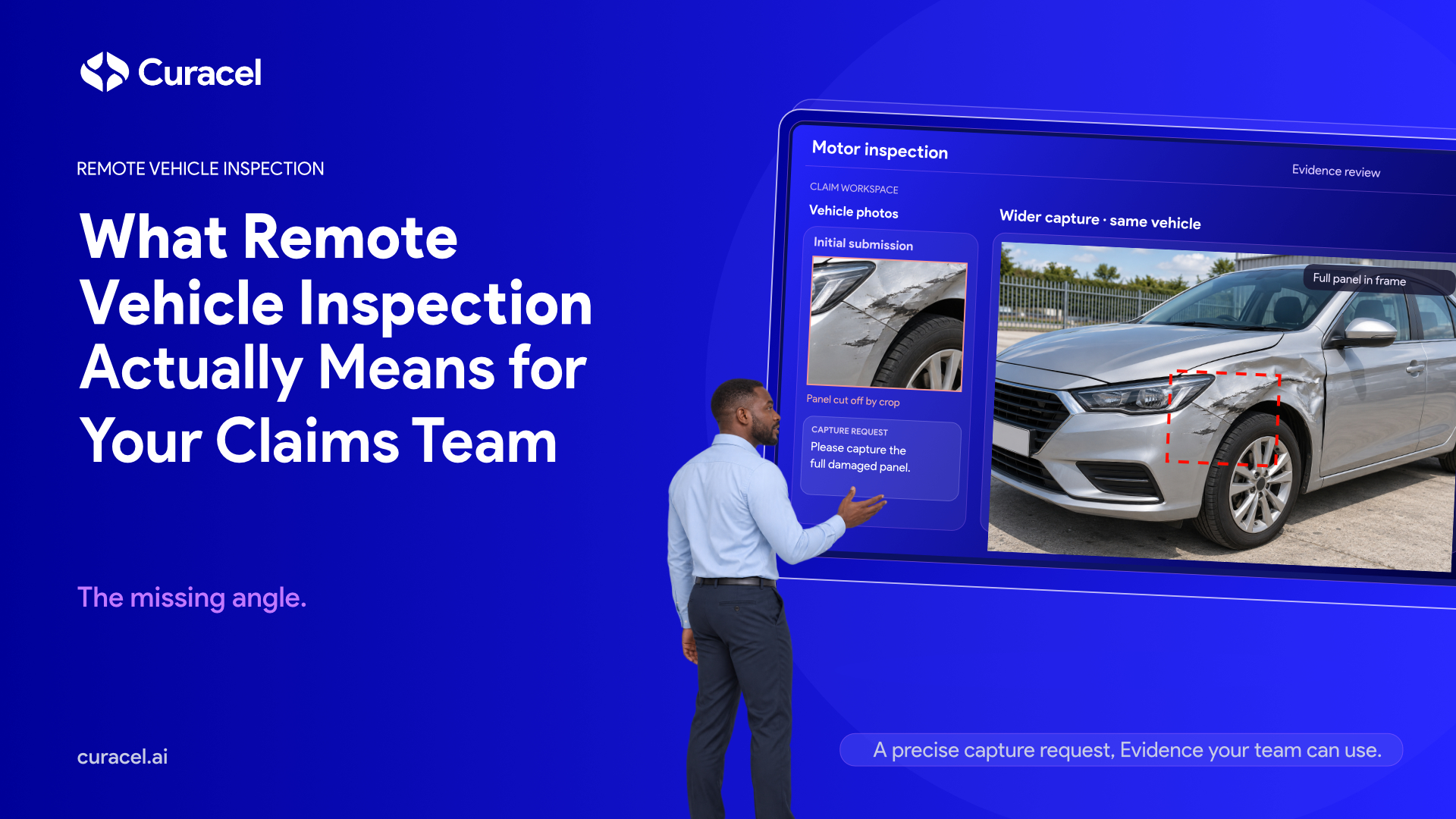
Your customer has sent vehicle photographs. Your assessor still can't make a decision. The registration is missing, one damaged panel is out of frame and nobody has said what evidence is needed next.
Moving inspection online hasn't removed the bottleneck. It has moved it into the claims inbox.
Remote vehicle inspection means assessing the vehicle's condition from evidence captured away from the assessor. For a claims team, the meaningful change isn't the camera. It's a repeatable path from customer capture to a reviewable assessment, with a clear route to physical inspection when the evidence isn't enough.
That path has to fit the market. In its State of Mobile Internet Connectivity 2024 release, GSMA reported that only 27% of Sub-Saharan Africa's population used mobile internet. It also reported a 60% usage gap: people within mobile internet coverage who weren't using it. Those regional population figures aren't a survey of insured motorists, but they warn against treating network coverage as proof that every claimant can complete a digital inspection.
Design the process around the decision your assessor needs to make. A policy-inception inspection records condition before cover. A post-loss inspection records the damage being claimed. They can use similar capture steps, but they answer different questions. Keep both records identifiable and available for comparison.
A practical remote claims workflow needs defined responsibilities:
- The customer captures usable evidence. Give clear instructions for vehicle identity, overall views and damage close-ups. Explain lighting and framing in language the customer understands, and offer assisted capture when needed.
- The intake team checks completeness. Resolve missing views before the file reaches an assessor. Ask for the exact missing image rather than sending a vague “please resubmit” message.
- The assessment process structures the damage. Map visible damage to the affected parts so the reviewer can compare it with the incident account and repair proposal.
- The assessor owns the decision. Decide whether the evidence supports remote review, needs clarification or requires an in-person assessment. Keep coverage decisions separate from image-analysis outputs.
Explore Curacel Auto's approach to remote inspection and motor claims.
Curacel's Auto product page describes remote first notification of loss through a series of images and questions, alongside pre-insurance condition analysis. Its damage-detection documentation shows a structured response with annotated images and fields for the affected part, damage type and severity. This is the mechanism: turning captured images into information an assessor can review.
It isn't a promise that every claim can be settled from photographs. Hidden damage, disputed identity or an inconsistent accident account can require additional evidence. Define those escalation conditions before the pilot starts, along with the person who books the physical inspection and keeps the customer informed.
Nor should “remote” mean “self-service only”. A claimant may have mobile coverage but lack a suitable device, affordable data or confidence taking the required pictures. Offer a practical alternative through your existing inspection network. Test capture instructions with the customers who will actually use them, not only with staff on office Wi-Fi.
Keep the original submission and every correction together so assessors don't compare different versions by accident. Test incomplete capture, contradictory vehicle details and uncertain repair scope, not only clean examples. Protect the source images and vehicle information with approved access, retention and transfer controls. A convenient informal channel isn't a substitute for a controlled evidence record.
Start with a bounded claim category that your team can assess from visible evidence. Agree the required views, review rules and escalation reasons before measuring results. Check the quality of decisions alongside speed:
- Capture completion. Measure how many started inspections produce a usable evidence set. Record why customers abandon the process.
- Repeat requests. Track how often the team asks for replacement photographs and which instructions create confusion.
- Review and escalation. Separate waiting time from assessor handling time. Record why a file moved to physical inspection.
- Decision quality. Audit whether the damage assessment supports the authorised repair decision and whether later findings change it.
The Takeaway
Remote vehicle inspection works when the customer knows what to capture and the assessor knows what to do with it. The goal is a usable evidence record, not simply a faster upload.
Build the capture standard, reviewer ownership and physical-inspection fallback together. Then judge the workflow on completion, decision quality and customer effort.
Talk to Curacel about a remote inspection workflow for your claims team.
Subsribe to our newsletter to receive weekly content