


Your AI Pilot Is Not a Workforce
A useful AI answer can impress a room. A financial-services workflow must survive missing documents, conflicting records and decisions that need a human signature.
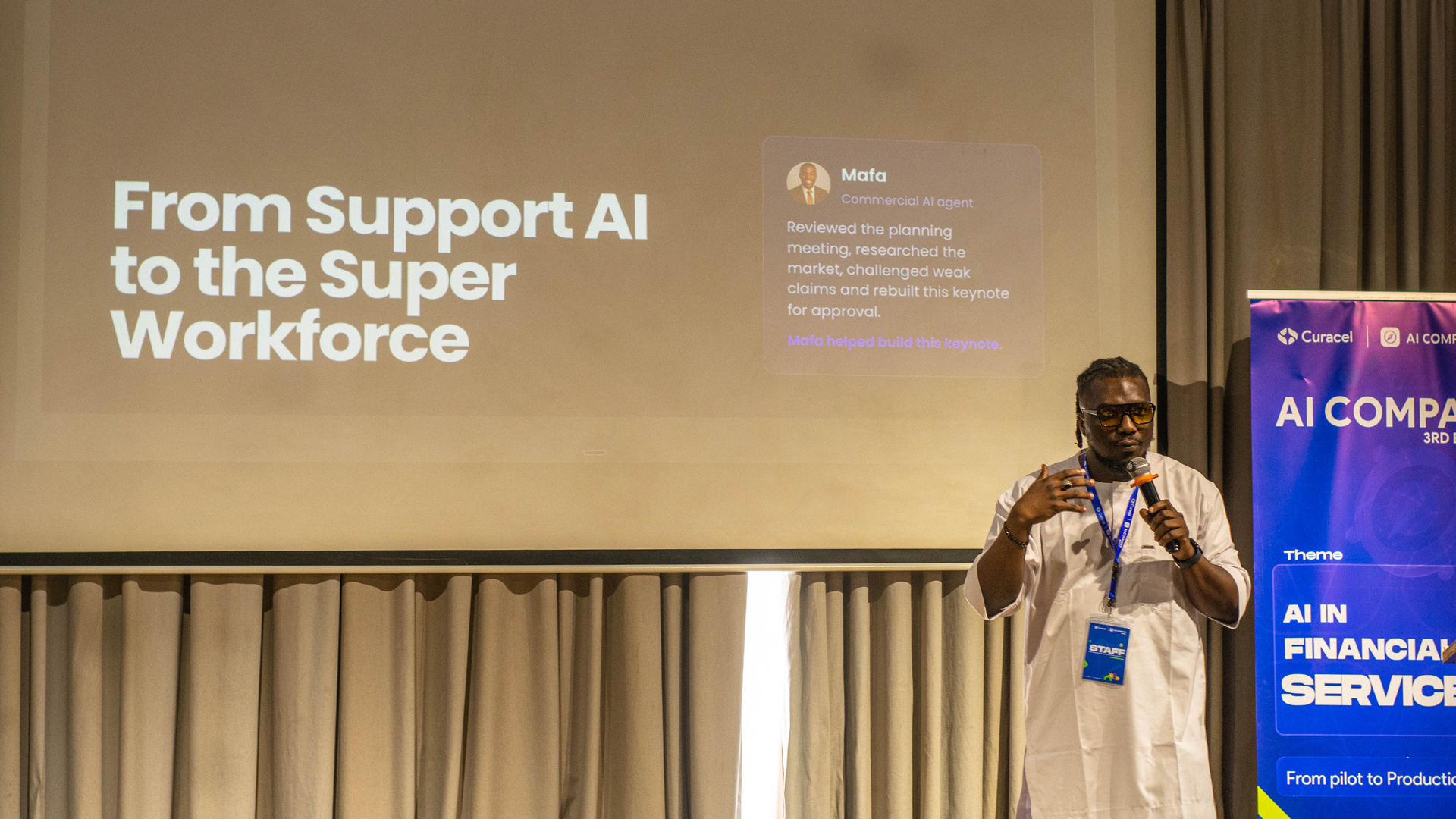
That gap framed Curacel co-founder and COO Abdul-Jabbar Momoh’s AI Compass Lagos 2026 session on “Agentic AI: Launching the Super Workforce.” His instruction was direct: “So think about bounded responsibilities and then the human in the loop still maintains that outcome review”.
The question for an insurer or bank is not whether an assistant can produce an answer. It is whether the institution can connect that answer to controlled, accountable execution.
The Capacity Gap Is Not Permission to Automate Everything
The Microsoft 2025 Work Trend Index found that 80% of surveyed workers lacked enough time or energy to do their work, while 53% of leaders said productivity needed to increase. Its survey covered 31,000 knowledge workers across 31 markets. Those findings describe a capacity problem, not a mandate to remove people.
Claims teams repeat document checks. Finance teams compare payment files, ledgers and bank statements. But a claims agent should not approve payment simply because a file looks complete, and a reconciliation agent should not post an uncertain match.
The opportunity is to remove avoidable effort while keeping decision rights explicit.
Define the Job Before Choosing the Agent
Momoh asked a practical question: “What things do you already have a playbook for?”
Start with a job, not a department. “Automate claims” is too broad. “Check a new motor claim for required documents, draft a missing-information request and route complete files to an authorised handler” is specific enough to test.
Map its trigger, approved sources, systems, permitted actions, exceptions and human approval points. Name the person accountable for the outcome. Define what the agent must never do.
This is where a pilot becomes an operating model. Context needs access controls. Memory needs retention and correction rules. Actions need permissions. Escalation needs an owner who receives enough evidence to continue the work.
Book a Super Workforce workflow assessment. Bring one process, its systems, approval points and current success metric.
Observe Before You Delegate
Momoh also stressed correction: “You can always tell it make this update, lock it to your memory.” A practical way to test that feedback loop is observation before delegation.
For a regulated institution, observation should mean controlled shadow mode. The agent can propose classifications, drafts or routes without taking consequential actions. Teams compare those proposals with actual outcomes and record exceptions before expanding authority.
This reveals the details a demonstration can hide: an unusual document format, a recurring payment-reference error or a customer situation that must go to a specialist.
The NIST AI Risk Management Framework offers a voluntary structure through Govern, Map, Measure and Manage. It is guidance, not a compliance certificate or a substitute for local law.
Scale by Evidence, Not Excitement
Measure the whole workflow, not the number of agent responses. For claims intake, that could mean cycle time, completeness at handoff, repeat customer contacts, handler overrides and escaped errors. For reconciliation, it could mean match quality, exception ageing and corrected false matches.
Drafting differs from sending. Recommending differs from posting a ledger entry. Keep access limited, record material actions and define rollback conditions. Expand authority only when the evidence supports it.
Curacel’s Super Workforce proposition should be evaluated against that standard: can people and agents complete a defined job repeatedly while the institution retains control?
Watch the Full Session
Watch the AI Compass Agentic AI session.
The Takeaway
An AI pilot proves that a model can help with a task. A workforce needs named owners, bounded permissions, human approvals and verified outcomes.
Define the job. Observe it. Validate the agent’s work. Add actions carefully. Measure exceptions as well as speed.
Book a Super Workforce workflow assessment and bring one repetitive financial-services process to move from AI assistance to accountable execution.
Subsribe to our newsletter to receive weekly content







.svg)


