


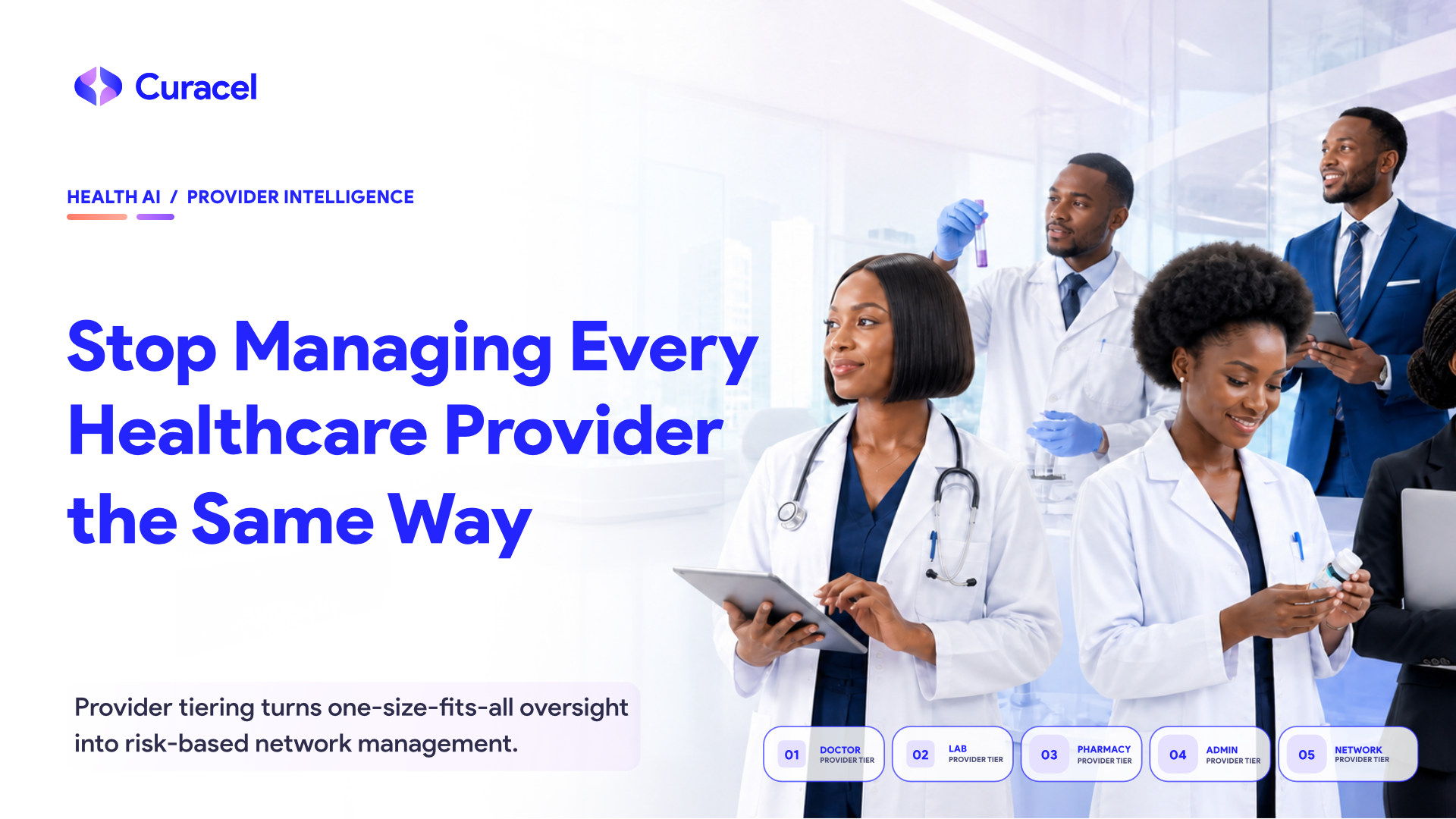
Stop Managing Every Healthcare Provider the Same Way
A tertiary hospital, a neighborhood clinic, a pharmacy, and a diagnostics centre can all sit in one provider network. That does not make their claims behavior directly comparable.
Yet many health insurers still manage providers with the same rules, the same thresholds, and the same review path. The result is avoidable friction for reliable providers and noisy alerts for claims teams.
Better provider management starts with a simple shift: compare like with like, then act on the difference that matters.
One Network Does Not Mean One Benchmark
Claims patterns reflect context. Specialty, patient mix, service profile, geography, and referral role can all change utilization and cost. That is why established performance-measurement approaches use risk adjustment and contextual comparison rather than treating every raw difference as a performance failure.
For a payor, the practical lesson is clear. A hospital should not be flagged simply because its average claim differs from a pharmacy’s. Even two hospitals may need different baselines if one handles more complex cases.
Segmentation makes the comparison more useful. Start with peer groups based on variables your team can explain, such as provider type, specialty, location, services, and patient mix. Then examine behavior within the right cohort.
Turn Raw Variation Into a Useful Signal
A strong provider view has three layers:
- Peer cohort: Which providers are genuinely comparable?
- Behavior signal: What changed in frequency, coding, utilization, authorization, documentation, or cost?
- Business response: Does the signal call for support, monitoring, clinical review, or investigation?
Claims-based outlier analysis can help surface unusual patterns. But unusual does not automatically mean improper. It means the pattern deserves context.
That distinction protects the network from two expensive mistakes: ignoring a meaningful change and treating a legitimate provider as guilty because an algorithm produced a score.
Want to see how your claims data could support a more focused provider-management workflow? Request a Curacel Health demo.
Match the Intervention to the Evidence
Segmentation is useful only when it changes the action.
- Support: Help an otherwise reliable provider fix documentation, coding, or submission issues.
- Monitor: Watch a new or weak signal across a defined period before escalating.
- Review: Route clinically sensitive or persistent anomalies to qualified human reviewers.
- Investigate: Escalate corroborated, material patterns through a documented process.
This is more disciplined than applying blanket preauthorization or manual review to an entire network. It also gives provider-relations teams a clearer explanation for each intervention.
The score is not the strategy. The response is.
Keep AI in Its Proper Role
AI-assisted analysis can make large claims datasets easier to review, but health decisions require governance. WHO guidance on AI for health and the NIST AI Risk Management Framework both emphasize accountability and trustworthy system design.
In practice, that means documenting the data and thresholds behind a signal, testing for unreliable patterns, protecting sensitive information, keeping qualified people in the decision loop, and giving providers a route to clarify or challenge a finding.
It also means measuring more than spend. A provider-management view should consider quality, access, member experience, operational reliability, and integrity signals together. Lower cost is not automatically better care, and higher cost is not automatically abuse.
The Takeaway
Managing every healthcare provider the same way can feel consistent while producing poor decisions. A better model groups comparable providers, detects meaningful deviations, and applies a proportionate human-reviewed response.
That is how claims intelligence becomes provider intelligence: not by making more accusations, but by helping teams ask better questions and act with more precision.
Explore Curacel Health or request a demo to discuss a provider-management workflow built around your network.
Subsribe to our newsletter to receive weekly content






.svg)


