


AI in Insurance Will Scale When It Knows When to Stop
“AI strategy must go from demo to decision to delivery.”
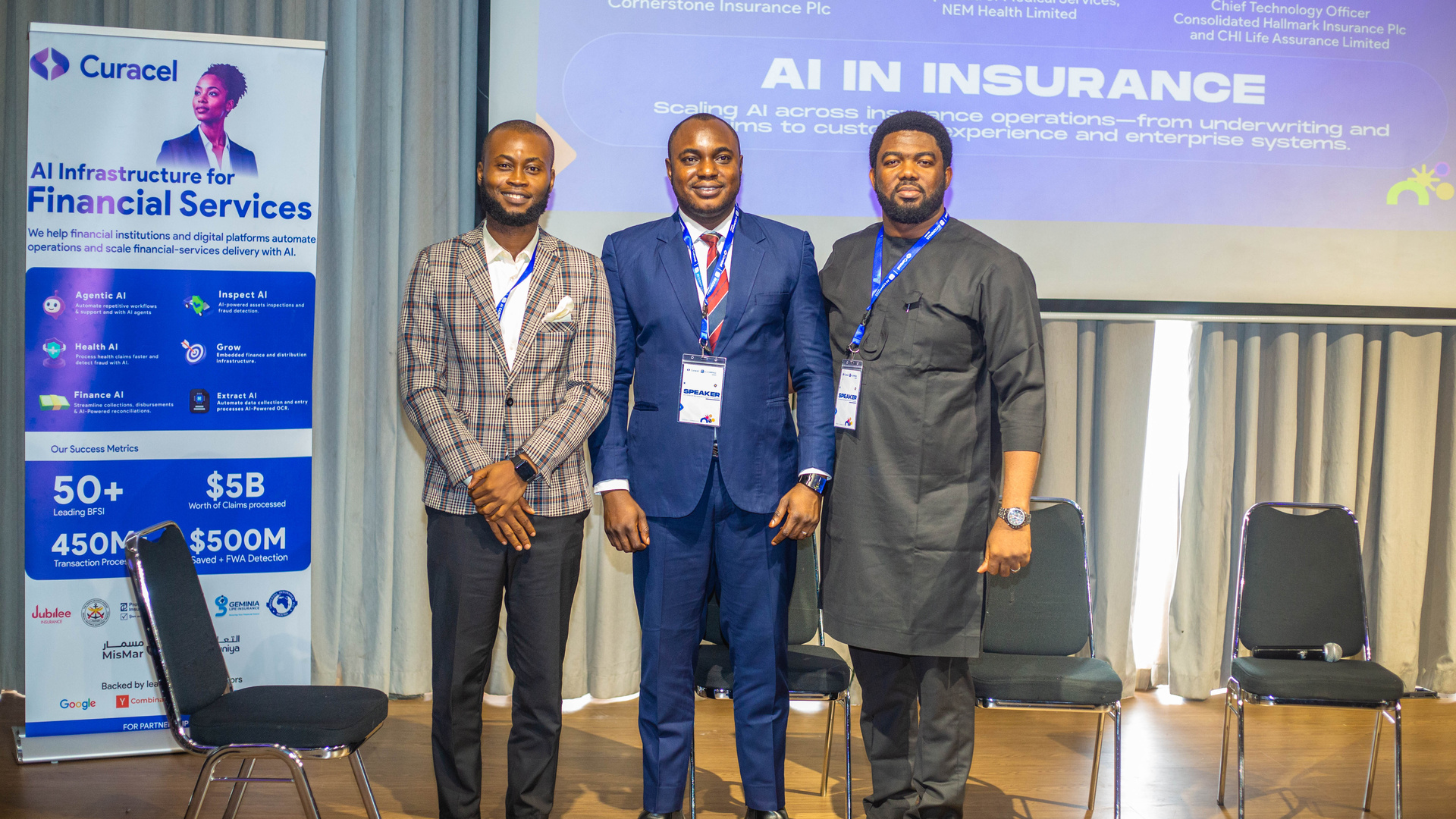
Segun Aboderin, Chief Technology Officer at Consolidated Hallmark Insurance and CHI Life, offered that line during the AI in Insurance panel at AI Compass Lagos 2026. It captured the challenge for insurance executives: a model demonstration can impress, but production must work with imperfect data, legacy systems, exceptions and customers waiting for help.
The panel’s message was not to automate less. It was to automate deliberately.
The Pilot Fails When Nobody Owns the Work
Oluwarotimi Adediji, Chief Technology Officer at Cornerstone Insurance, described an early AI-assisted vehicle inspection project whose adoption stalled until the team revisited ownership.
“We are just an enabler. We are just a conveyor of the technology,” he said of IT’s role.
Claims and underwriting teams own the decisions and customer handoffs. Technology connects the system, but it cannot own the operating result for them.
Before approving a pilot, name the executive owner, process owner and person accountable for exceptions. Record the current cycle time, manual effort and error cost. Define what AI may recommend, what it may execute and what it must escalate.
Automate Evidence Before Judgement
Insurance teams collect documents, inspect vehicles, compare treatments with benefits, check duplicates and flag anomalies. AI can assemble that evidence and help people focus on cases that need judgement.
But a faster recommendation is not automatically a fair decision.
“It's a business of trust. It's a business of empathy,” Aboderin said. Dr Sanni Asishana, Group Head of Medical Services at NEM Health, made the healthcare boundary explicit: “AI can advise in healthcare faster, but we need somebody to say this is a true rejection or this is a false rejection.”
Section 37 of the Nigeria Data Protection Act 2023 gives people a right not to face solely automated decisions with legal or similarly significant effects, subject to stated exceptions and safeguards.
The practical answer is risk-tiered authority. Let AI extract, compare, detect and prioritise. Permit straight-through action only inside clear thresholds. Send low-confidence, high-value, disputed or consequential cases to an authorised person with the evidence needed to decide.
Bring one high-friction claims or inspection workflow and its current turnaround time to a Curacel demo.
Production Requires Monitoring
Insurance data sits across policy, claims, finance, provider and customer systems. If staff must copy data between screens or customers restart at every handoff, the model has moved friction rather than removed it.
Monitoring matters too. Adediji recalled a voice bot returning an answer from the wrong insurance context. His team caught it because they reviewed responses and traced faults.
A production control loop should show what data entered the model, confidence in the output, which cases were escalated or overturned, and what happens when a model, vendor or connection fails.
The NIST AI Risk Management Framework is voluntary, not Nigerian insurance regulation. Its Govern, Map, Measure and Manage structure is still useful: deployment starts oversight rather than ending it.
Measure Speed and Trust Together
Curacel’s published Cornerstone case study describes customers recording a vehicle video, computer vision assessing it and a structured report going to underwriting or claims. Curacel reports that pre-policy issuance moved from days to hours, with many assessments completed within minutes after upload. This is a first-party case-study result, not a universal benchmark.
The value is not simply “we use AI.” The customer can complete an inspection remotely, the insurer gets standardised evidence and the responsible team can decide faster.
Measure cycle time, completion rate, false positives, human overturns, complaints, escalations and customer drop-off. A workflow that is fast but often contested is not finished.
The Takeaway
Insurance AI scales when it knows what it may automate, what it must escalate and who owns the answer.
AI can collect evidence faster and detect patterns earlier. People handle ambiguity, consequence and empathy. Workflow design makes the two useful together.
Bring one workflow, one baseline and one customer pain point to a Curacel demo, and design the path to production around measurable value and accountable review.
Subsribe to our newsletter to receive weekly content





.svg)


